

Mid-August is Product Camp Melbourne, organised by Product Anonymous. I wanted to go for the last couple of years but couldn’t make it, so was quite excited to go — and present!
Below are my impressions of the conference, and some notes of the talk I gave together with Cam Ross — all about the different demands of product leadership, and how to tell if it’s for you — which I hope you’ll find enlightening.
Short version: worth coming to Melbourne for the conference, and product leadership is all about the people 😜
Product Camp is an unconference. This means that, apart from the keynote, attendees have 30 seconds to pitch their talks, votes are collected (physical dot voting), and then whomever get selected fills up the later sessions.
It is run completely by the community and for the community, with volunteers to organise and sponsors to pay for location, coffee, food, coffee, prizes, tea, and after-party. Pretty amazing achievement for a community-run event.
Actually, that’s part of the charm. A lot more human-centric than the slicker, corporate-run conferences. My deep thanks and admiration to Liz & Jen from Product Anonymous, to Steve Bauer the MC, and the hordes of cheerful volunteers. I’m grateful for the chance of connecting in person to people I only knew as talking heads on zoom (Steve, Lucy, Marco), and for all the new Product friends I made (Maxy, Jana, Nandhini, Jack, William, Yau, Pavi, Vijay… I’m never sure if it’s better to name people risking forgetting a few — please don’t be offended!)
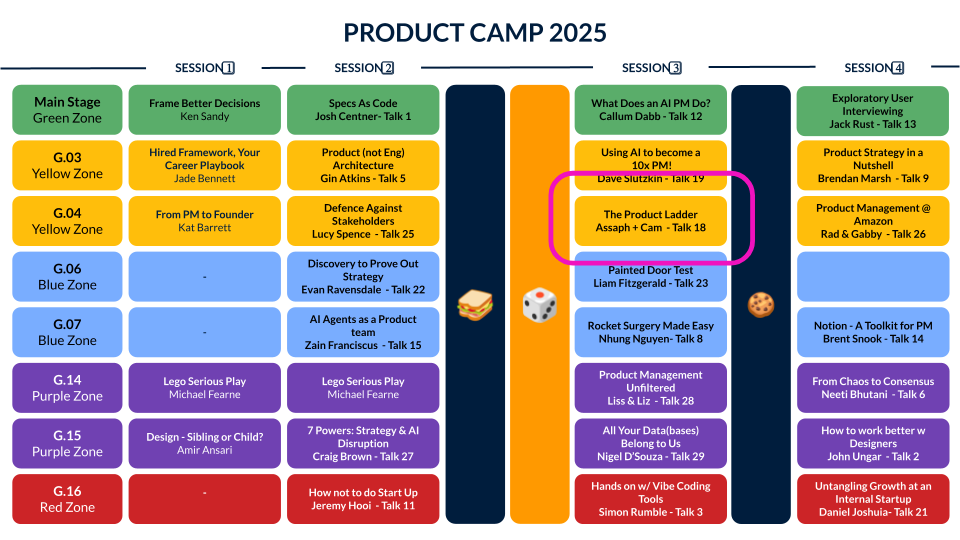
Anyway, Cam and my talk about “Who’s insane enough to want to be a CPO?” got voted in. This was no-slides, just “telling it like it is” and sharing our scars from HoP / executive roles. We both had them, and went back to IC roles.
Some key-takeaways if you’re curious:
It's all about the people.
"Politics" is the role..
Navigating people and egos at a whole different level than you’re used to, which simultaneously being more removed. You’ll get to understand why executives seem to have ADHD.
You need to be sure you can work and get along with the specific people you’ll be surrounded with. Don’t ignore red flags (including gut feelings!) about the people when interviewing.
You’ll need external support, you won’t have a ‘home team’ of peers as such. Find a mentor or executive support group.
You will be operating at different scales
Building a product and team (PM) > building an organisation and portfolio (director) > building a market (CPO).
It sounds exciting, but…
The skill that got you here, won’t get you there (even if they sound the same). It’s actually much less “Product” work.
It’s nothing like the books. Being a mentor and being a line manager are very different, and despite your best intentions, you’ll be doing more line management than mentoring.
It's not the only path
Consider ahead of time if this is the right path for you (don't chase title or pay). Consider why you want a leadership role: don’t assume you’ll automatically be able to do more (people won’t “just” listen), and think about what you’re giving up (team, harder to find next role).
Product skills are transferable to other fields, leadership isn’t the only path.
As for the obvious question: will we take another executive role? In both cases that answer was: yes — but it has to be absolutely the right thing. We won’t take it just because we feel it’s the thing to do, we’ll take it because we believe we can work with the people and make an impact.
Both Cam and I are open to chat with anyone and help them think through career choices. Just reach out to Cam or me on LinkedIn.


Top-left: Marco Tebaldi (a conference volunteer and fellow Squizzer), Cam, and I; Top-centre: with Jack Rust, being “interviewed”; Top-right: with the amazing Lucy Spence; Bottom: Cam and I talking about the realities of leadership/executive roles.
Speaking of Lucy, her talk — Defence and Stakeholders and other Vampire Hunters — was pretty amazing. It ended up being a very funny, useful, and included very candid talk about all the “hard won” lessons (read: career limiting mistakes) in stakeholder management. She also absolutely put everyone else to shame with her hand-drawn slides. I suggest you watch her recorded trial-run here.
The other talks I attended:
Keynote my Dr Maria Camacho about design thinking. Nice to hear people talk about it, and even though I know the subject getting fresh perspectives and new anecdotes is always welcome.
Lego Serious Play: an interesting technique to elicit thinking with tactile method from a group. It’s essentially going around conscious ‘deep’ analysis, and into story-telling. Great in person when you have big questions (and lots of Legos 😁).
Exploratory User Interviews, with Jack Rust. If you ever worked with me you know I love doing them, and I write often about the topic (as well as how to be subversively helpful to get access to customers). So when Jack asked for volunteers I tentatively put my hand up… and found myself on stage again. It was fun being the interviewee for a change! (And I also got to talk a bit about AI). It was a live ‘demo’ that Jack used to highlight techniques and principles about exploratory interviews. If you weren’t there, I always recommend Talking to Humans by Giff Constable.
A talk I would have loved to hear but missed, was Product Architecture by Gin Atkins. Luckily you can find the article behind it here on Substack.
In short, it was an amazing conference, and I hold deep gratitude and awe to Liz and Jen from Product Anonymous and all the volunteers who organised everything. I’m hoping to make it to Melbourne next year as well!
(And if you can’t wait to meet in person and need so career or product management advice — just reach out! I’m always up for a chat 😊)